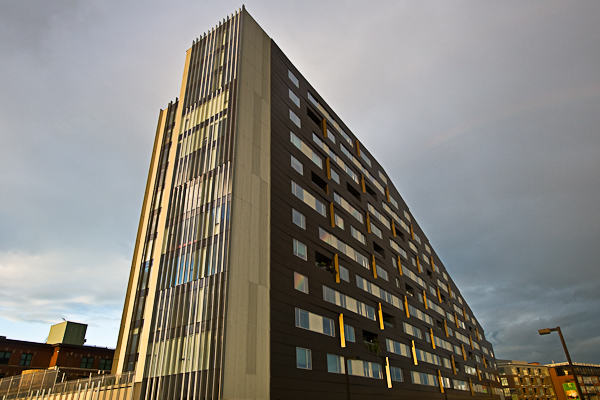
Recently I was in South Boston to take pictures of the Macallen condo building. Directly across the street is (what I think is) an MBTA bus depot, and I took a few photos in that direction to capture a rainbow that appeared after the rain. As I was leaving, an MBTA SUV pulled up with two people inside and asked me what newspaper I work for. I said the photos are for a photography class I’m taking. They responded quickly something about warning me that I wasn’t allowed to take photos on or of MBTA property and drove off. It struck me as a little silly since Google provides satellite imagery and certainly a small camera could be more easily concealed than my bulky SLR.
This left me wondering what the MBTA photography policy actually is. I remember two years back that there had been some protesting by the Mass. ACLU over the MBTA’s photography ban without a permit. For a while the T Transit Police website had the policy available, but the site has since gone away (replaced with an early-90s-era “Under Construction” image). And while neither archive.org nor google had a copy, a kind netizen sent me a copy of the current MBTA photography policy (pdf).
The policy seems pretty reasonable, although I’m not sure why tripods are thought to be so disruptive. Hopefully it will become more well-known among MBTA employees (still plenty of stories about getting yelled at for taking photos), or at least photographers can print out the MBTA’s policy.


August 29th, 2008 at 6:54 am
The main issue with tripods, at least in stations, is that they can obstruct pedestrian flow and cause a tripping hazard, especially for the visually impaired.
August 29th, 2008 at 7:28 am
This is the first I’ve heard of MBTA goons going to that level of illegal harassment. They must be really scared that people will see what their facilities look like. See, for example my guerilla photography at (http://mcgath.blogspot.com/2008/05/porter-square-garbage-dump.html).
August 29th, 2008 at 7:35 am
It’s still sad the MBTA employees don’t know their own policy, and go and harass people on public property…
August 29th, 2008 at 8:08 am
@Ron Newman: you’re completely right, but I wish they would say “don’t obstruct pedestrian flow” rather than ban tripods & monopods explicitly. There are plenty of uncrowded times & places in T stations where it wouldn’t be a problem.
November 1st, 2008 at 12:59 pm
I was at Riverside recently and the station manager told me to stop taking photos with my iPhone.
I suppose not too many employees know about the official policy and I am guessing the MBTA management would like to keep it that way. If they can continue to operate in a gray area, they can enforce their non-official policy of keeping people from taking photographs and still appease the ACLU with their official paperwork.
On the other hand, I’d like to see them try and stop us.
January 26th, 2009 at 10:22 am
I was wondering what would happen, when I go off and shoot pictures in various T-stations. Of course I did not google anything beforehand, and just went off. So, yesterday I had a several hour shooting at Government Center and nobody bothered me. Granted, it was Sunday, but there were MBTA officials around. They did not seem to care….
Anyhow, I will bring from now on the official policy with me each time I go so I can finish my project..
http://transitpolice.us/Photo%20Policy/Photo%20Policy%201.pdf
May 25th, 2009 at 6:04 pm
Wittingly or not, anyone who takes photos on MBTA property challenges a long-established, apparently long-cherished - and unwritten - rule against photography on “T” property.
It is anybody’s guess how long this has been going on. I personally can attest to being yelled at and threatened with arrest - in one case along Huntington Avenue, for filming Green Line trains from the sidewalk - as long ago as 1970. In other words, almost 40 years, four decades and two generations ago.
This “unwritten rule” might - “might” - date back to World War II. It might date back even farther (although I consider that unlikely). In any case: To the best of my knowledge, MBTA had not released documentation that the long-established previous “policy” was ever written. Nor has MBTA explained when, why and under what authority the previous “unwritten rule” banning photography was adopted.
MBTA’s “unwritten rule” photography was evidently part of Boston life for decades - or generations. In addition, it was apparently not challenged - until now.
In similar fashion, San Francisco cable car staff enforced a ban against female passengers standing on the running boards of cars. Girls and women who stood “outside” were asked to move “inside.”
As far as anyone knows, the “custom” or “rule” was enforced literally from the first day cable car service, in 1873. Also, as far as anyone knows, no one ever challenged this rule.
Then, on February 2, 1965, a 19-year old University of California (Berkeley) student named Mona Hutchin refused to comply with requests by cable car crew members that she move “inside.” She was arrested.
As was reported widely at the time, S.F. police found that San Francisco had no law forbidding women from riding on cable car running boards. (I believe that this was known to police “before the fact.”) Hutchin was charged with resisting arrest, but acquitted. The management of San Francisco’s transit system attempted to get the city to pass a law forbidding women from riding cable running boards, but city council members refused. And that, as is said, was the end of that.
Back to Boston. MBTA rank and file have enforced an “unwritten rule” against photography (“because they can”) for ages. This certainly permeates the established “institutional culture” today - and has for a long time. In short: don’t give in, but don’t forget that old habits die hard.